

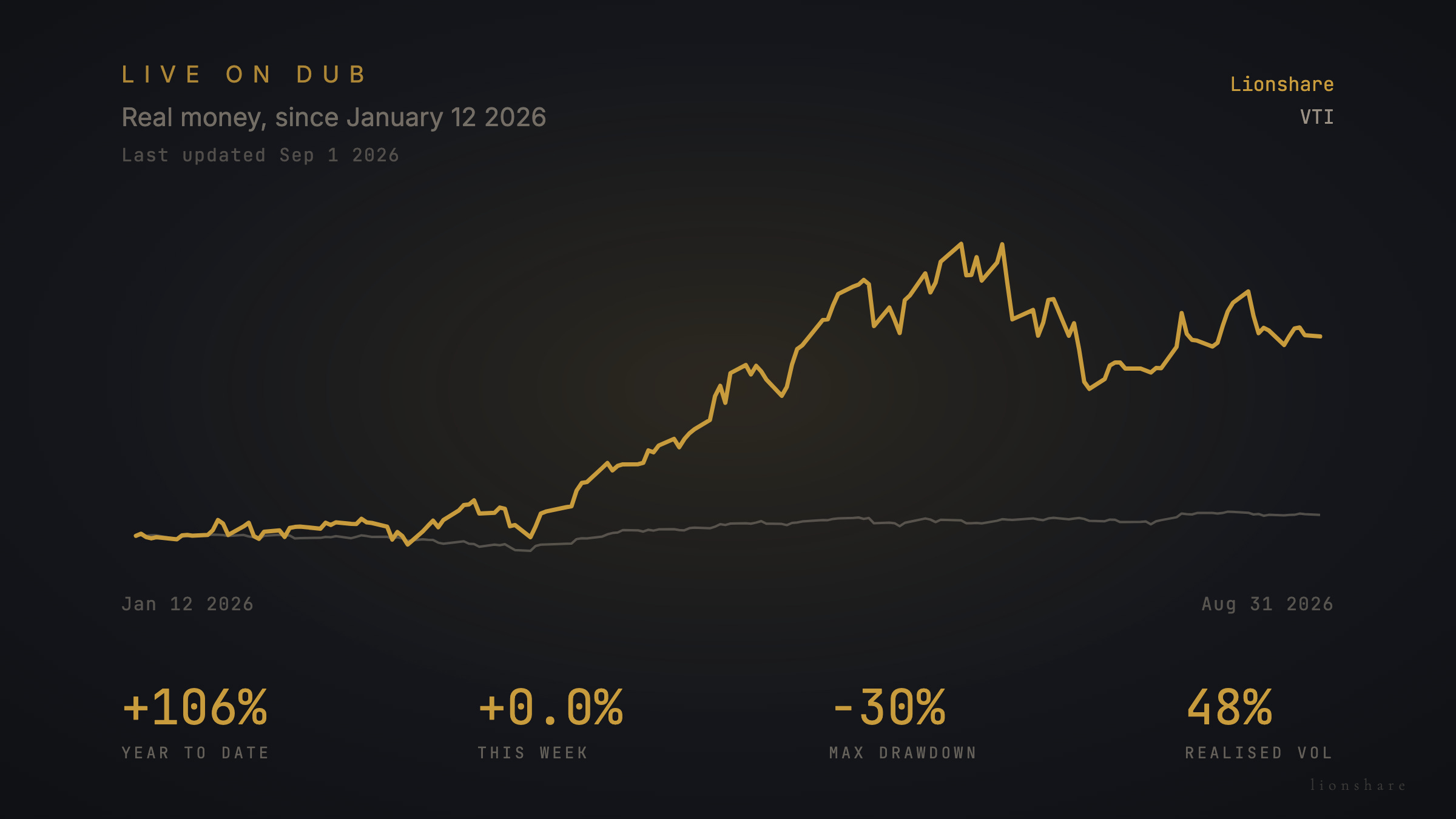
On July 17 the account was worth $53,530. Five weeks earlier it had been $76,751.
That is a drop of -30.3%, the worst this record has had, and most of it arrived inside one week when the portfolio gave up -21.2%. The Monday after, I ran the process exactly the way I run it every Monday, which at that point felt like doing nothing at all.
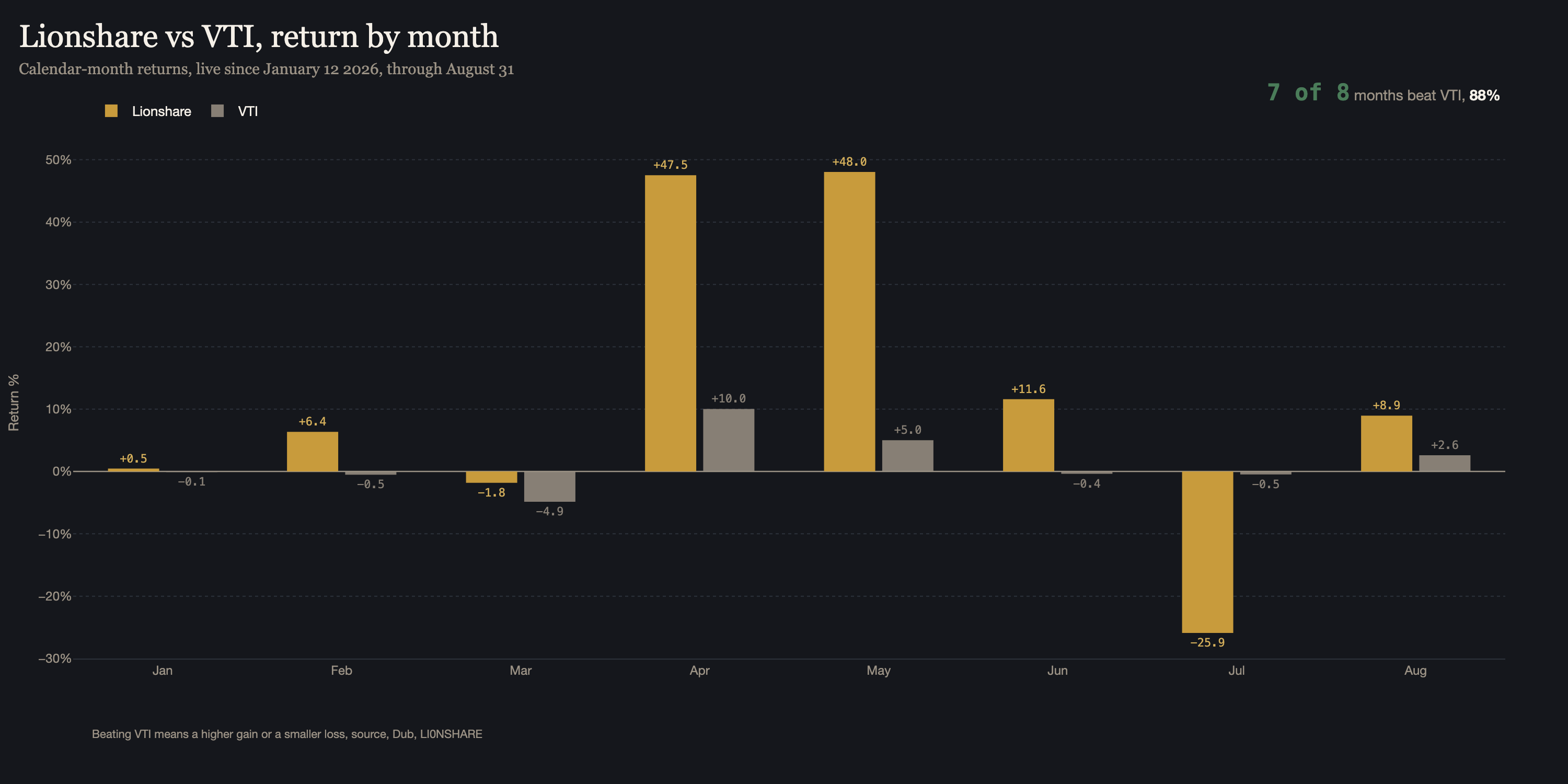
August closed at +8.9% against the market’s +2.6% and the account finished at $61,918. This is how that happened, and what I found during the month’s review.
The scorecard
                              Lionshare     VTI      Spread
                              ─────────    ──────   ───────
August                            +8.9%     +2.6%     +6.3%
Live, since January 12          +106.4%    +11.2%    +95.2%

Months ahead of the market       7 of 8
Worst drop since going live      -30.3%     -8.6%
Below the June high              -19.3%
Account, from $30,000           $61,918
Every number here comes from Dub, a third-party platform that tracks the portfolio live and open for anyone to see. On Dub the strategy runs the hard way, without stop losses, without exact timing on the Monday open, and with fees on top. I treat it as the source of truth anyway, because a record kept by someone else, one I can’t touch, is the most useful thing I can hand you. It’s all there, down to the detail you’d need to rebuild every figure above.
The Monday at the bottom
On July 13 the portfolio held 30% of the account in one memory stock, 25.8% in a second and 16.5% in a third. That is the shape the scoring produces when conviction is high, and through the spring it had been right. Then the week to July 19 took -21.2% out.
Normally after a large drop someone would have done something dramatically different that Monday, but the system didn’t change.
It kept the names it still rated, switched the conviction weighting off, and spread the money across twenty-five positions at 4.0% each, still fully invested but with the concentration gone. A week later, with the market no better, it stepped down again and moved 70% of the account into cash, leaving twenty-five names at 1.2%.
Two step-downs in two weeks, neither of them a decision I made. Nothing about those Mondays repaired the hole, and on July 17 it was still -30.3% deep. What they did was make the portfolio small while conditions weren’t optimal, and leave it able to get large again when the reading changed.
What August was made of
On August 3 the reading changed, and the account went back into ten concentrated positions. It did three things that morning, not one.
It put the cash back to work.
It swapped almost the whole list for different names.
It sized those names steeply,
30%in the top one down to under1%in the smallest.
Any of the three could have made the month, so I decomposed August into four analysis to better understand the returns. The first analysis is if nothing changed and just holds July’s defensive list all month. Then I add the three decisions back, one at a time to show what that one was worth to the results.
                                        Return   Incremental value
Change nothing, hold July's list         +1.0%
  put the cash back to work              +3.4%       +2.4
  swap in the new names                  +7.4%       +4.0
  size them 30% down to 1%               +8.3%       +0.8
Swapping the names was worth 4.0 points, more than the other two decisions put together. Putting the cash back to work mattered, but only as permission for the rest, because the names I had been holding would have returned about 3.4% fully invested and the market did 2.6% anyway.
What produced August was the system selecting and rotation into memory, storage and the machines that test chips.
The engine runs in both directions
So the month came out of a concentrated bet on one corner of the market, which makes concentration a valuable part of the system. Two positions show what that looks like from the inside.
ALAB was held for exactly one week, returned +13.5% at a 30% weight, contributed more to the month than any other name, and was gone by August 10. WDC sat in the top 30% slot for three of the four weeks and finished the month contributing -0.36%. Across those weeks it went -17.1%, then +20.9%, then -15.1%, then +2.4%.
The same weight ladder that made ALAB the month’s biggest contributor made WDC a round trip. Run August again with the same ten names each week at ten percent each and it comes out at +7.43% rather than +8.25%, so across the whole month the steep sizing added 0.8 points. Inside the month it added six points in one week and cost five in the next.
That 0.8 says more about August than about the sizing. Putting 30% into one name pays when the move keeps going, and August never really trended as a market. The market made its whole month in the first two sessions, +3.3% by the close on August 4, then spent the next nineteen sessions going nowhere, finishing 0.7% below its August 4 level. Fourteen of the twenty-one days moved less than half a percent, and after August 4 the entire index traded inside a two-point range. Steep sizing in a market like that gets you churn at the top of the ladder rather than a run, which is roughly what happened to WDC.
And the corner of the market it rotated into on August 3 is the corner it was sitting in on July 13, when the same conviction ran the other way. Same mechanism, same size, opposite result five weeks apart.
That is the design working in both directions, and it is why the good months are the size they are.
So is it just a wilder portfolio?
That is a fair question, and it needs arithmetic to assess.
The objection runs like this. A portfolio that swings 4.5 times as wide as the market will beat it in an up month without anything clever happening, so +8.9% against +2.6% proves very little on its own. Fair enough, and there is a clean test for it. Take the whole US market, run it at exactly the volatility this portfolio ran at, 60.7% a year against the market’s 13.4%, and see what it delivers over the same days.
                                      Live, since January 12
The market itself                            +11.2%
The same market at 60.7% volatility          +47.7%
Lionshare, at 60.7% volatility              +106.4%
Matched for risk, the index gets you +47.7% against the +106.4% the account made with a -30.3% drop inside it. The 59 points between those two are what the weekly scoring is for, and no amount of extra size would have produced them.
There is a second form of the same test that I like.
Sharpe measures the return you got against how much the portfolio moved around to get it, and Sortino does the same while counting the downward moves alone.
Neither can be improved by taking more size, because more size multiplies the return and the movement in the same proportion and the ratio between them does not change.
                    Lionshare     VTI
                    ─────────   ─────
Sharpe                    2.2     1.3
Sortino                   3.2     2.0
Both metrics are well over one and a half times the market’s.
One month is far too few days to calculate a ratio like that from, so both run across the whole live record, which is 160 trading days and still a short run.
Where it leaves things
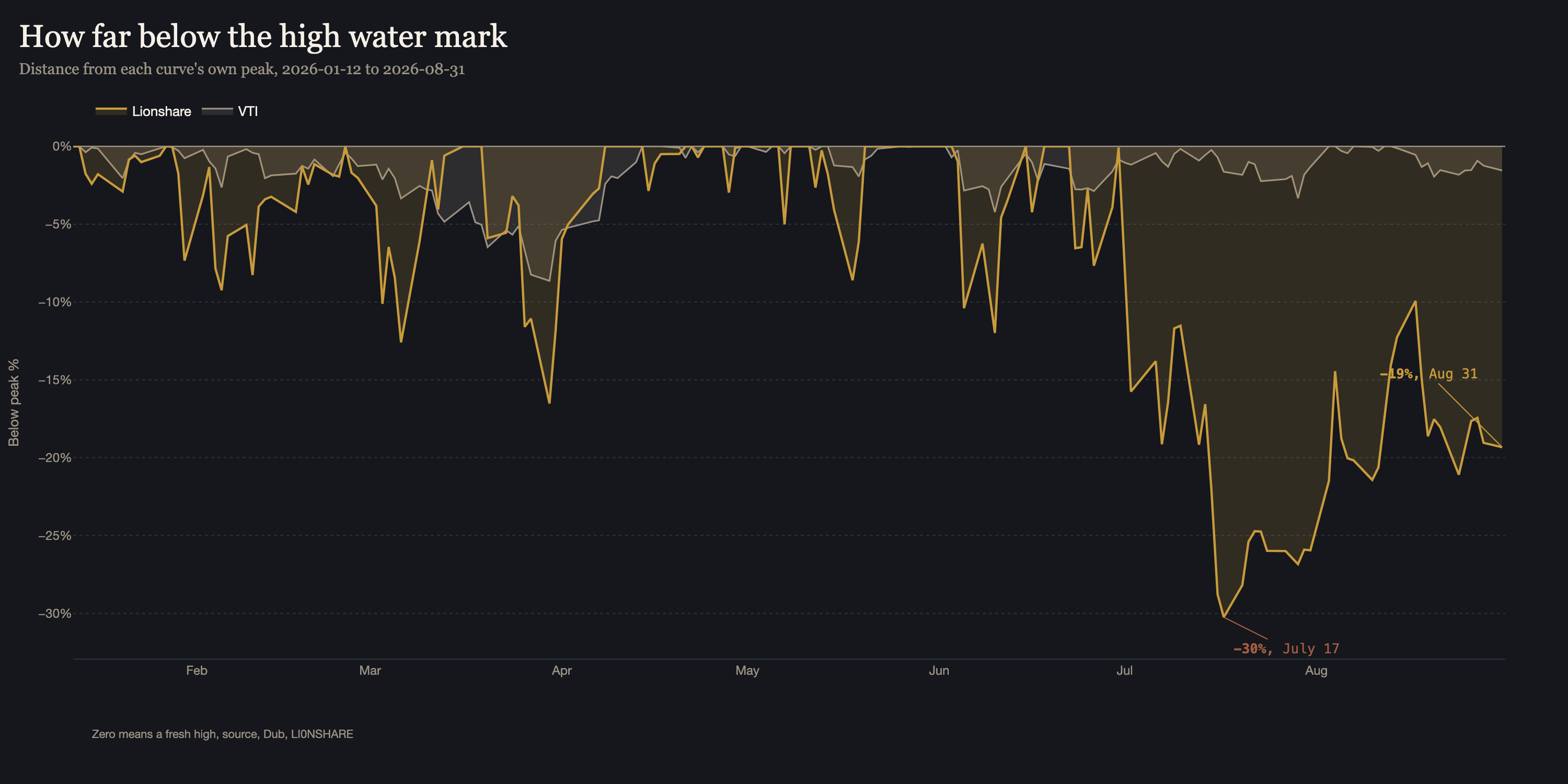
August carried the account from $53,530 at the July low to $61,918, a climb of +15.7% that still leaves it 19.3% under the June high, so the hole is not closed yet.
This Monday the system moved back to 70% cash across twenty-five equal-weighted names, out of memory and semiconductors and into energy, insurance, packaging and food. Nothing about the process changed, only what it found. The same two step-downs it ran in July, for the same reason, and I have no idea yet whether that will look early or late.
I run around two thousand US stocks through the scoring from a blank sheet every week, so nothing carries over because I liked it last week, and placing the result takes half an hour on a Monday morning. Paid subscribers get that list before the open, every position with its weight and its stop, and the same list is what goes into my own account when the market opens.
Eight months ago this was a strategy I believed in. It is now one that has been through a
-30.3%drop and come out the other side without me overriding it.
With $30,000 at $61,918 in Lionshare against $33,350 for the same money in the broad market. That is a different thing to own, and the whole of it is dated and public.
See it for yourself
The weekend update lands free every Saturday, up week or down week, written the same way either way.
Found this useful? Restack it and send it to one person who’d want it too. It’s how this reaches the next reader, and it makes a real difference to me.
Take the lion’s share.