
Start here, About, How a Monday works, FAQ, The backtest
The short version
Join a simple stock strategy built for growth. The exact positions I hold arrive in your inbox every Monday before the market opens, and take 30 minutes to follow.
It has beaten the market since going live in January 2026, and every trade is public.
If you would rather see one than read about it, here is the Monday list from August 24, open to everyone. The positions are old, but it is exactly what arrives.
The Backtest, Live track record on Dub
Why I built it
You already know the right stocks can grow your money faster than a basic fund. The hard part is knowing what to hold this week, when every feed and newsletter has another idea.
I had the same problem. I am Seb, an electronic engineer with a full-time day job. For years I picked my own stocks and read the analysis services. The information was insightful, but turning it into a whole portfolio, and keeping up with everything that could move it, was a second job I did not want. At one point I had nine indicators on a spreadsheet. Each said something slightly different, and I noticed I was picking whichever one agreed with me that morning and calling it analysis.
Engineering taught me to trust systems I can test. So I built one for my own money: rules that do the same thing every week, tested on past data before any of it went live.
The portfolio went live on Dub with $30,000 on January 12, 2026. My goal is to grow it to $1 million, in the open, one Monday at a time.
The year so far
January. On the first Monday with my own money in it, I was nervous. For the first few weeks the account hardly moved, and I was a little disappointed. Then it started to grow faster than the market.
June and July. The portfolio fell 30%. Some days swung hard, and my stops sold a lot of my holdings. It was a mixed bag of feelings. I knew from testing that a fall of that size was within the worst the strategy had been through, so I kept following it, and I published every week of it.
October. The portfolio sat out of stocks for weeks, in one fund. On every good day in the market my gut said to jump back in. I followed the rules instead, because a tested process is worth more to me than a feeling.
Every Monday. The list goes out before the open, and then the week is mine: work, marathon training, a fantasy novel, a new recipe for dinner.
What you get
Every Monday before the market opens, the exact positions I hold arrive in your inbox, each with its weight and its stop. You copy them in your own account in about 30 minutes, and the rest of the week is yours. There is no research to do and no charts to watch.
It is the same portfolio I run with my own money, so what you see is what I hold.
The free tier gets the weekend review every Saturday. It reports the result for the week, up or down, written the same way either way.
The paid tier, $39 a month or $350 a year, gets the full Monday list before the market opens. The weekend review comes with it.
You can cancel anytime in one click.
How it works
Behind it is a set of tested rules that adapts to the market. Each week the system scores several hundred large US companies on five things: how good the business is, how fast it is growing, how it has done against earnings expectations, how cheap it is, and how strongly its share price has been rising.
Most weeks that means ten stocks, with a few large positions doing most of the work. The largest can be 30% of the portfolio. When conditions turn against stocks, it steps out of them and holds a single fund until they improve. In testing that was about three weeks in ten.
I keep improving it, and changes are tested on past data before they go live, because my own money depends on it.
The record
Every trade has been public on Dub since January 12, 2026. I set it up so I cannot edit it, which was the whole point of putting it there.
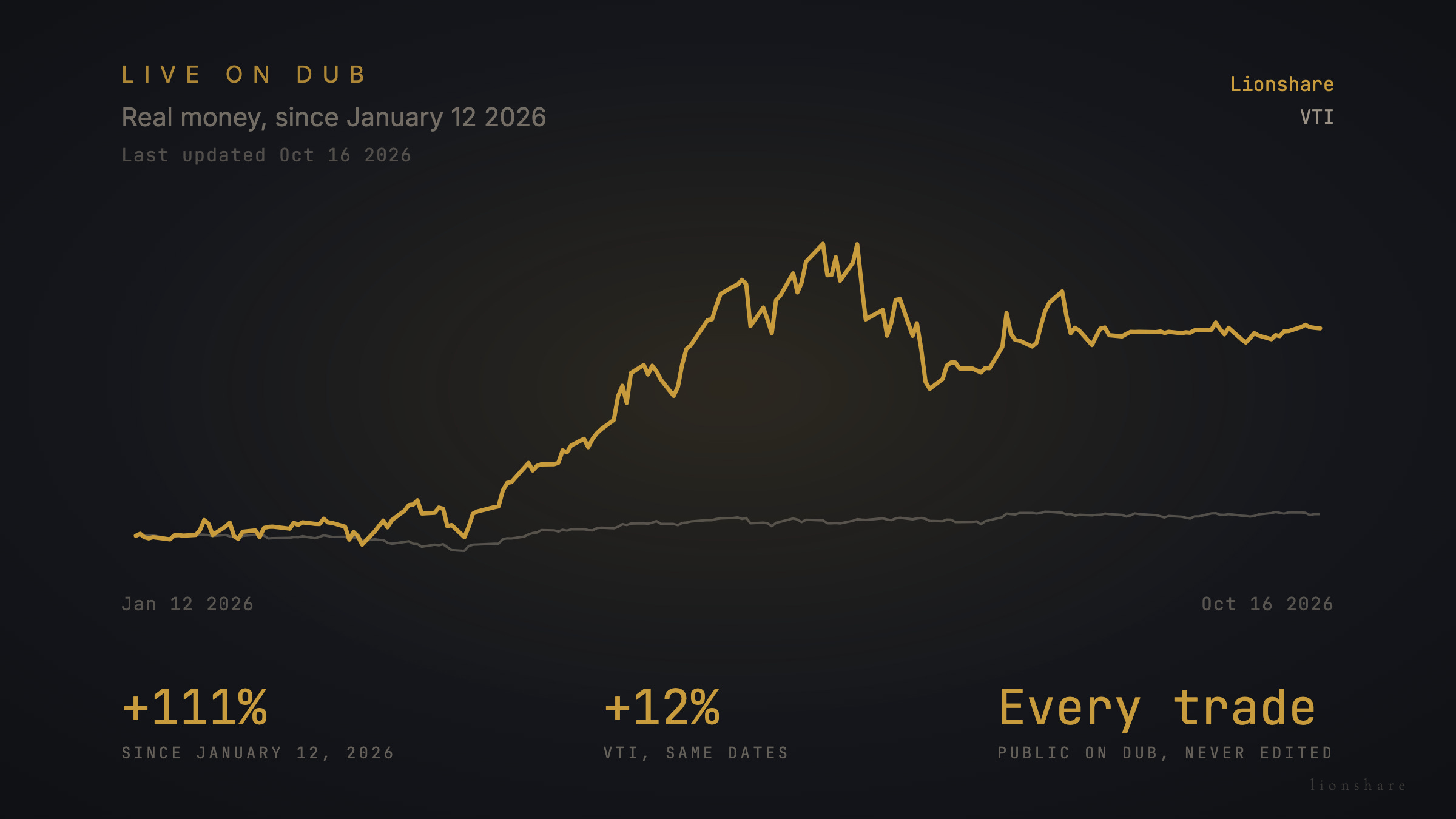
As of October 9, 2026 the live portfolio is up 109% since then, against about 13% for the broad market. The winning weeks and the losing ones sit next to each other, exactly as they happened.
The posts here are a second record, going back to May 2026. Every Monday list is dated before the market opens and stays in the archive, so a paying reader can go back to any week and see what I planned to hold before anyone knew the result. Every Saturday review then reports how that week did, and those are free for everyone. The archive is here.
Before going live I tested the strategy on past data, and I still test every change. The full results are on the backtest page.
What to expect
It is built for growth, and growth comes unevenly. In testing, a few strong weeks made most of each year and about four weeks in ten lost money. The portfolio is concentrated, so it can fall hard, as it did in June and July, and a future decline could be deeper. Some weeks the list is one fund and there is nothing to trade.
It suits someone who can follow it every week and sit through that.
Who this is for
Someone who already invests, can place a trade in their own account, and wants a complete portfolio to copy more than another idea to research. You can be anywhere, as long as you can trade US stocks. The weights are percentages, so the list fits most account sizes. With a broker that takes orders in dollar amounts it works from about $1,000.
It is not for someone who wants advice, needs help placing a trade, or needs it to pay every month.
What a Monday looks like
It is 7:30 in New York, two hours before the open. The list arrives, one line for each position: the ticker, its weight and its stop price. At the open the orders go into your own broker with the stops set at the same time. That is about 30 minutes, about one coffee, and then the rest of the week is free. Every step is in How a Monday works, and the rest of your questions are in the FAQ.
Getting started
The free tier is the simplest start. The weekend review arrives every Saturday, and you can watch the record for as long as you like before you pay anything. The full list goes to paying readers every Monday before the market opens. It is $39 a month or $350 a year, and you can cancel in one click.
Lionshare is a publication, not financial advice. What you do with your own money is your decision.