

Since May 27, Robinhood has been allowing customers to connect their own AI agents, such as Claude, to a separate account which can execute their trades. Nearly 100,000 customers have opened these accounts by the end of July.
AI is an incredible tool that can compress a lot of information into a logical summary. Its fundamental use case is to be able to accurately predict what the most likely next piece of information is and build a logic chain from that. So the short answer is that AI definitely can trade for you. It has the capabilities to perform the tasks needed from scanning the market, identifying the meaningful pieces of data and building a logical point of view as a conclusion. It also has the technical capabilities to access an account, place orders and the other tasks associated with trading. The next question is not if it can, but rather if it should trade for you? My point of view on this is that it should not, but it does have a place as a tool to make you a better investor.
I graduated in Electronic Engineering that gave me the experience of software and hardware development with a focus on building reliable and scalable systems. The use of AI (and any new technology in general) has always been interesting to me and I lean optimistic on its impact on the future, but I still view it as a tool that needs to be used in the right context to solve the right problems.
The portfolio that I run with my own money is up 99.8% as of November 6, 2026 from the 12-January 2026 period, while the S&P 500 index with dividends is up 7.3% over this period. The trades are publicly shared on Dub that measures the performance to VTI, a fund that is designed to hold the entire US equity market. In this article, I'll explain where I use AI, why it never picks a single stock, the 2 tests that my trading strategy needed to pass before I would back my own money behind it, and what I would give to an AI agent to be executed through a brokerage platform.
Building a strategy that has an edge is possible through the use of AI as a thought partner. I had an idea of how I want to build my own trading and investing strategy based on my learnings from the markets. What I used AI for is to accelerate the testing and experimentation of the strategy to help refine it.
I use AI mostly as a coding agent and if I want to learn about a new area quickly. As a coding agent it is super useful to quickly iterate on ideas and try new things. I used to write my own code and that's how Lionshare originally started as a manual build of a machine learning model, but the use of LLMs to write code has become really useful. As a learning partner it allows me to quickly understand different topics and get a head start to unpacking ideas and then I can go deeper into my own research and reading with a wider base of knowledge.
Using the latest tools allows you to accelerate work. This can be very useful if it is working from a strong base with a clear idea, but can be equally frustrating as it can amplify a bad idea. The sweet spot is using your own knowledge, experiences and expertise to direct the work in a structured way.
I set the rules and environment in which AI is allowed to operate. I also have checks in place to ensure consistency across different runs and backtests so that it's possible to see if a core function is broken.
Lionshare's strategy is a rule based approach that is reliable and repeatable across many years of data which simply means that the algorithm it uses runs a repeatable assessment of the different equity stocks that are open for us to invest in to score each of them and then selects the top scoring stocks to hold for the week. There is no AI in this loop that assesses any of the stocks.
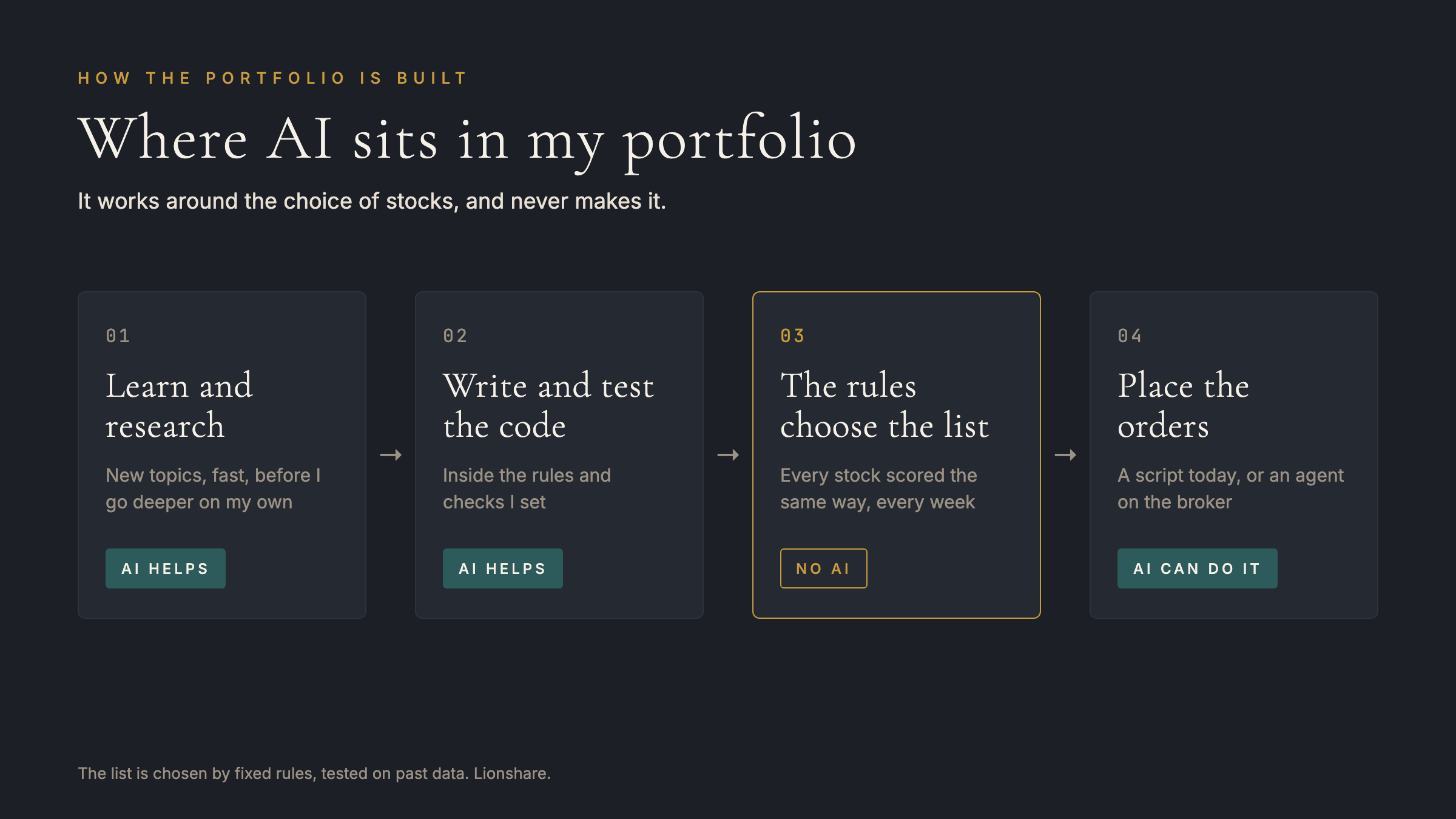
Where AI is used in my portfolio is that it helps with the research, coding and placing orders while the rules select the stocks to buy or sell.
The reason I don't use AI in the algorithm or process is because AI is not reliable and repeatable.
I have asked AI for an opinion on a holding or to make a projection for stock prices. What I've found is that slight changes to context can produce vastly different recommendations and that models still aren't completely free from hallucinations.
When you are making an investment you want to be sure that you are making the right decision. This is already difficult enough if you have the right facts at the right time in the stock market, but becomes that much more difficult to do when the information or recommendation keeps changing. Let's use an analogy, imagine you are doing your own investment research and you decide to invest in a company today and write down your reason in your journal with the key figures and reasoning that made you decide on it. A few months later the investment isn't performing so you want to understand where you made a mistake in your analysis or thinking. You go back to your journal and what you wrote for yourself has changed for some reason. You lose the ability to build a meaningful learning or improve your own process.
The secondary reason is that you cannot backtest the models, they already have the context of markets and equities built in so they have look ahead bias and I'm not comfortable running a strategy that I haven't been able to backtest across a few different years. Backtesting is the process of evaluating how the system would have behaved under historic market conditions. I've shared an article about how I do backtesting for Lionshare and some common watch outs to be mindful of to ensure the test is reliable. GPT-4o is capable of accurately recalling historical stock index levels to within an average error of 0.61% for dates pre training cutoff, but has an average error of 16.9% for post training cutoff dates.
Lastly, the AI models are dependent on the provider's latest releases and can be changed at any time. This is a big risk to me as I want a strategy that can be repeated for many years on end without the dependency of someone else changing it. Anyone that's been using some of the publicly available LLMs over the last few years would have noticed that at some points the same models start to feel "dumber" or new released version of models respond differently than they have before. So unless you train your own model on your local hardware you are dependent on the provider to maintain the model and if they change any of its weights or context then your process changes.
Judgment calls are the ones you make based on your current view of the market and it's really difficult to distinguish between a real signal to act on compared to a recency bias or fragmented view. I rather trust a system that has been backtested across multiple years to have all the data and make a factual call that I can then later review. This doesn't mean that the system is perfect or that it can predict the market, but it definitely is right more often than I would have been if I had to choose for myself.
There is one exception that is well known, that in 2023 Finder, the comparison site, asked ChatGPT to pick 38 stocks one time, without any real money, and by March 2026, that fund was up 57.8% against the top UK funds' 36.5%. So does this change my views?
No and in some way it strengthens my view. It's easy to get distracted in the market by the one case that worked which in this case is an isolated test of a single model that made a few picks once and never again. I'm sure there are so many different cases where the models underperformed significantly which are not spoken about so survivorship bias is doing a lot of heavy lifting within how new models are shared in the media to have performed in stock picking. It also goes to show how the model isn't the main concern here. If all ChatGPT models could figure out the stock picking then we would have seen so many different investors just using it to have amazing returns, which is not the case. You still fundamentally need a strategy that has some kind of sustainable edge. It is difficult enough to develop an edge that matches your expected returns and approach in the market and this is even more difficult if you think that LLMs are generally trained on what's widely available which leads to regression to the mean.
So simply put, the LLMs are generally really good at conforming to the mean which is the worst place to try and build a differentiating edge.
There is a fun example that came up that illustrates this which is based on the recent FIFA World Cup. The question is why so many players all wore pink boots on the field? The reason is due to the brands of the boots all having the same research findings which is that the pink used is the opposite on the color spectrum compared to the green pitch. All of them had the unique insight about the color spectrum, then they all produced the same boot and none of the brands stood out from the rest so none of them gain meaningful value from the sponsorship.
A rule can be wrong but it is also testable and traceable. There will always be ways to improve the strategy and I keep working and trying new things to see if I can find these improvements. By being able to backtest and find the decision points, evaluate them with other alternatives and incrementally adjust I can start finding ways for the system to make smarter decisions that will improve future returns. So even if a rule is wrong now, at least it is consistently wrong which can then be improved for accuracy. The study of Six Sigma process improvement captures this well.
Before you can optimize a process, you have to make it stable, predictable, and repeatable.
It had to pass two hard tests. The first was the backtest which had to show consistent performance across a meaningful amount of time. The second was to reproduce the backtest profile on a paper traded account. This was to ensure that the backtested strategy can hold up in real world conditions without risking any funds to test it. After a few months of the paper trading account performing in line with what the backtest was showing I was confident enough to add my first real capital behind the strategy.
I would let an LLM or AI handle the order placement and execution. It is so much more efficient to let the AI handle your transactions if you know the portfolio you want to hold. It can get through the ordering process much faster and is able to handle the complexity of the live market well. Where I don't want to use AI is in the decision making of the final portfolio, I believe there should always still be a human in the loop that understands the overall goal and strategy to make the decisions.
The way that I would use AI now to simplify the order placement and adjustment of the portfolio every week is firstly through Robinhood's agentic capabilities. Every week you can pass along the table that has the exact positions, their weights in % and their stop loss levels. The connected agent can then do the updates for you and share the confirmations making it easy to follow the strategy. Some brokers don't yet have this capability so I used to share the table as a screenshot to my preferred model and then also share a screenshot of my current holdings with an instruction to calculate the differences and provide a list of sells and buy orders with the target amounts so that I can easily follow the list.
I have tried Robinhood Agentic trading. It's impressive how well an Agentic tool can handle the transactions needed for investing through different order types and management of the account. I felt a little nervous setting it up but luckily Robinhood allows you to have a separate part of your capital that is dedicated to Agentic trading and not expose your full investments. I still prefer using Alpaca API with a deterministic python script that places the orders for me but I'm excited for the future and how these new tools can reduce some more of the friction points in the investment process.
The fact is that all of these tools should help us achieve the same goal which is to grow our wealth while giving us more time to do the things we love. So use any tool that delivers on this and matches your investment style or approach. I personally use Lionshare as my strategy that requires only 30 min a week at the Monday morning open. The system is reliable and repeatable and has steadily built that trust for me.
Simplicity scales while complexity is the enemy of execution.
Having to rely on AI to make the decision on what stocks to hold each week would make the process too dependent on the quality of the model and their providers to use the strategy for a large amount of money and over the long term.
I will continue to use AI in my personal and work life to find ways to free up my time from tasks that I don't want to do. As for investing with AI, I do not yet trust AI to be the final decision maker or sole advisor so I will continue to use and improve on Lionshare's strategy that is rules based and repeatable for the years to come.
The list is sent every Monday prior to the market open and the results on Saturday. The whole record is on Dub so anyone can track it.