

live track record on Dub · more about Lionshare · 6-year backtest· FAQs
Six months ago I started sharing the strategy I run with my own money, publishing the exact stock positions, their weights, and the stop levels every Monday. The whole track record has been live and public on Dub the entire time. Here’s what thirty minutes every Monday added up to over six months.
The record so far
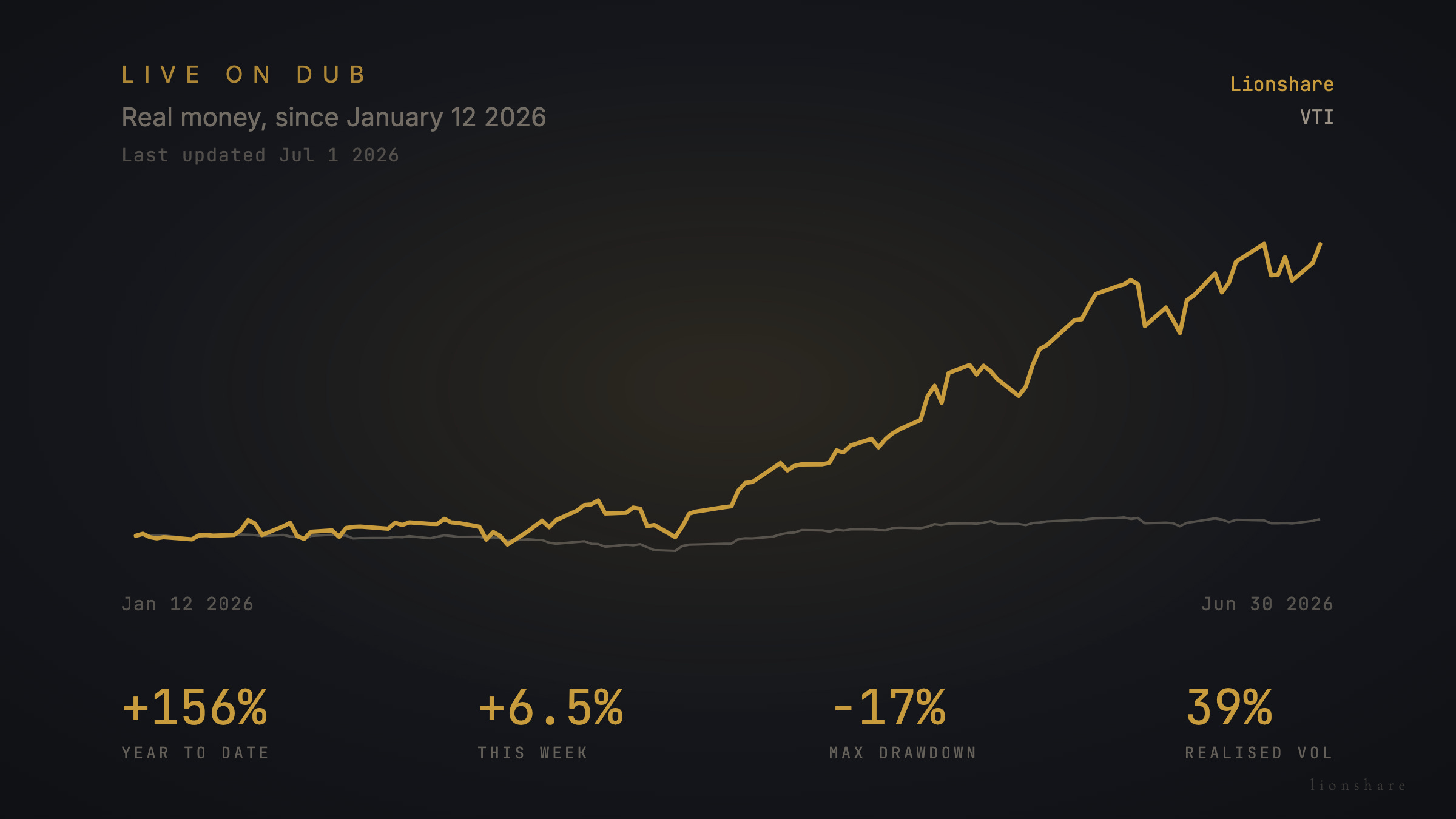
Lionshare vs the market (VTI), live since January 12
Return since inception · +155.7% vs +8.9%
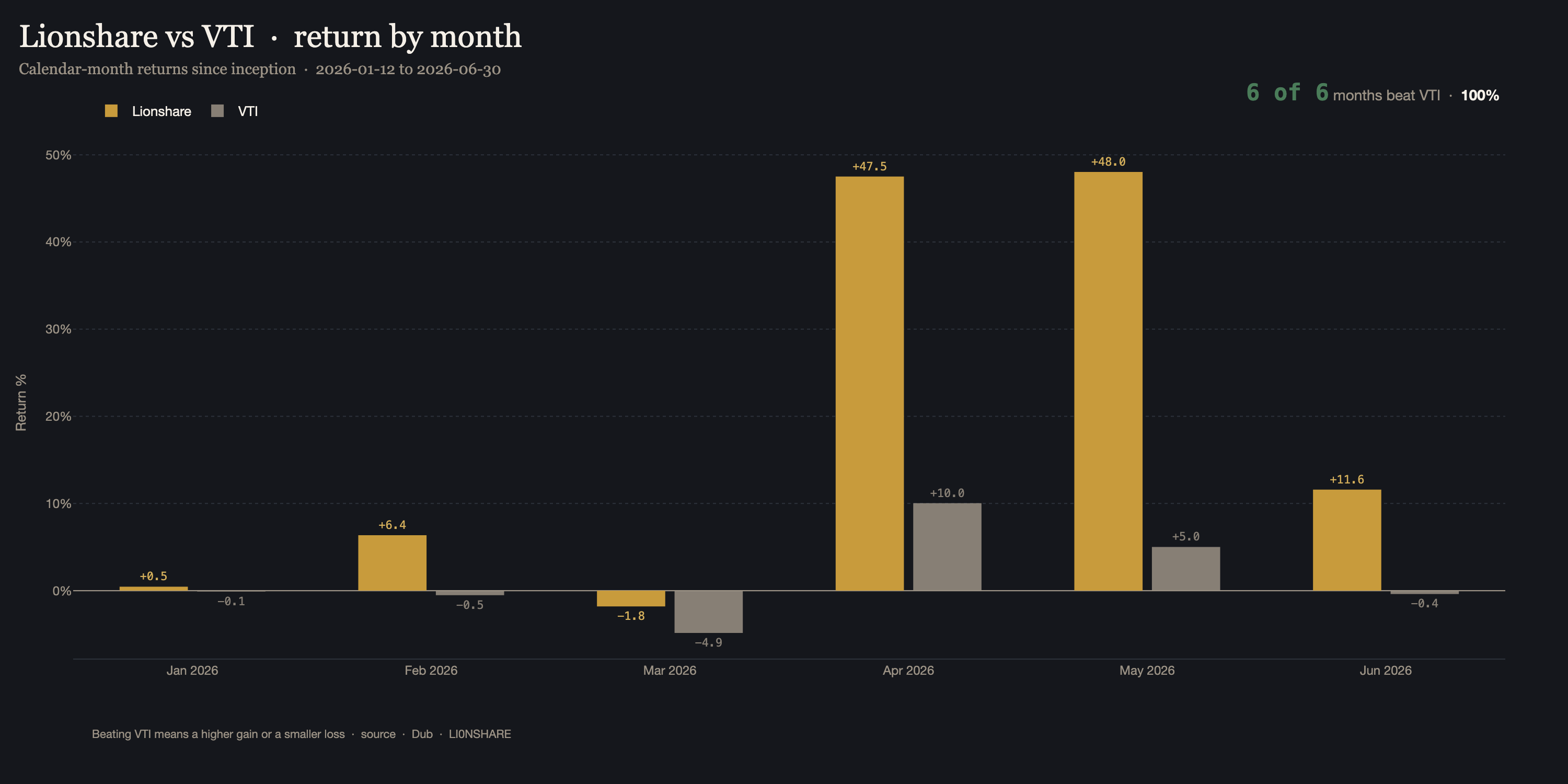
Ahead of the market · 6 of 6 months
Positive returns · 5 of 6 months
Worst drop · -17% vs -9%
Sharpe · 3.8 vs 1.4
Sortino · 6.1 vs 2.0
Every number here comes from Dub a third-party platform that tracks the portfolio live and open for anyone to see. On Dub the strategy runs the hard way, without stop losses, without exact timing on the open, and with fees on top. I run it there because a record kept by someone else, one I can’t touch, is the most useful thing I can hand you. It’s all there, down to the detail you’d need to rebuild every figure above.
The fuller picture
Six months in, the portfolio beat the market every single month, six for six, and finished green in five of the six. A live account, real money, tracking close to what six years of backtests said it would do.
Where the returns came from
Look at the month by month chart and two bars jump out. April and May did most of the heavy lifting, and those were also the two months the broad market moved the most, up about 10% and 5%. When the market runs, this is built to run harder, and it leans into the move.
The other months pulled their weight too. In March, when the market fell close to 5%, the portfolio gave back less than 2%. It catches the runs and cushions the falls. That’s the shape I’m after.
Those two big months are the strategy doing what it’s meant to do, sitting in the right names while the market moved and staying there. That’s the whole job. It doesn’t promise the next big month, and nothing from here is guaranteed. The pattern is the design, and for six months the design has held.
Sitting through the drawdown
The drops come with the territory. The worst stretch took the portfolio down about 17% before it climbed back. Through it I did what I do every other week, followed the system as written and let the stops do their work. Staying with it is what keeps you ready for when conditions turn. Every Monday the scoring reads what the market is rewarding now and moves the portfolio toward it, so when the picture changes, the book changes with it.
No stock portfolio is perfect against drawdowns. This one is built for growth rather than a smooth ride, so it moves around more than the market does. Watching it climb back out of its drops inside these first six months, and not just fall into them, is a good sign this early.
The risk-adjusted numbers say the same thing. Sharpe and Sortino measure how much return you’re getting for how much the portfolio moves around to earn it, and on both the strategy comes in at more than double the market. The extra movement is earning its keep.
It fits how the strategy is built. It doesn’t win by being right most days. Day to day the portfolio moves around a lot. The edge is in finding a small set of names with room to grow, letting the winners run a long way, and cutting the losers early with a stop I publish every week. Fewer bets, bigger when they work, closed fast when they don’t. This was never meant to be a calm, straight line. It’s built to compound, and to do that it has to move. If you can sit through the swings, that’s the trade it offers.
Easier to follow than ever
I’m making this simpler to follow than it has ever been. Every Monday brings ten positions, down from the fifteen or so it used to be.
The reason is simplicity. This only works if it stays a thirty-minute job on a Monday and nothing more, because it was never meant to become a second one. Ten positions means fewer orders to place and fewer changes each week, which makes the whole thing easier to keep up with, week after week.
The engine underneath hasn’t changed. The same scoring that picked the names and set the stops through these six months is the one carrying on. What I reworked is how it handles risk across a smaller book, so ten names hold the same expected return and the same risk that fifteen did. The names it lets go of are the smallest tail positions, the ones that barely moved the outcome anyway. Across the full six years of testing, ten behaves almost exactly like fifteen. Same character, same risk, nearly the same returns, with less to do each Monday morning.
See it for yourself
Everything here is free, and every trade behind it is public. If you like to check before you trust, good, so do I. The whole record is on Dub, open for you to go through whenever you like.
Verify every trade on Dub: here
Learn more about the system: here
Read the backtest details: here
Paid subscribers get the ten positions before the open every Monday, each with its weight and its stop, the same ones I place with my own money that morning. That list is the part you act on
Found this useful? Like it, restack it, and send it to one person who’d want it too. It’s how this reaches the next reader, and it makes a real difference to me.