
I think the most surprising thing about a stock portfolio that you can copy is that you would expect to copy someone that is able to forecast the market, knows exactly what's going on in every minute. They do all of the analysis, the research, they're watching charts and indicators, and then they provide you with the signals to trade on. Whereas Lionshare is the opposite. I don't know what's happening in the market at any given moment specifically. I am not able to forecast the market when there's a top or a bottom and I don't need to.
Over the last few months, I barely know the exact conditions in which different stocks are picked or not. But I have a system that I fully rely on and that I backtested that does the thinking and the analysis for me to provide a simple portfolio of about 10 stocks every week.
So how does it work?
Let me introduce you to Lionshare, which is my trading portfolio that I use my own money on to grow my own wealth at a rate faster than the index, and it has been beating the market since January 2026 when I first started sharing this live and publicly.
Lionshare is a stock portfolio that anyone can follow. It takes about 30 minutes a week to replicate and it is shared with an email to the paying subscribers at 7:30 a.m., two hours before the stock market opens every week, with the exact positions, their weights and their stop levels to place in their own accounts, and then the rest of the week, there's no other changes or monitoring needed, no indicator levels or recent news to keep updated with.
The portfolio just does its thing and the next Monday it refreshes. So Lionshare fundamentally is based off of an algorithm that I created.
My background is in electronic engineering and systems design. I've been doing that for a while and I applied it to the financial markets.
I aim to have a portfolio that is super simple to follow, that is completely transparent in its performance to whoever is following it, and to show that in some weeks it will do well. In some weeks it will decline and underperform the market, which is natural.
So Lionshare is a portfolio that cannot forecast what's going to happen in the market, but does a really good job of finding the few meaningful stocks that the market is seeming to reward in the moment. It picks these stocks, assigns the weight to them, assigns their stop levels, and enters them every Monday morning at the open. Repeating this process has been successful so far. Since January 2026, when I went live with the portfolio with my own money, it has outperformed the market significantly, growing 114.4% to October 28, while the S&P 500 with dividends grew 12.7% in the same period, which is giving me confidence to keep going and share this with others.
And it also aims to share completely transparently the performance and history of the portfolio since it started on January 12, 2026. I do this by sharing publicly on Dub a live performance link that anyone can verify and I cannot edit.
And secondly, every week I publish the email of the portfolio before the market opens. And then on the Saturday morning, when the week closes, a transparent review if the week was positive or negative to close out the performance.
In this post I will explain the difference compared to other ways that I have tried to follow someone else's portfolio, what you would hold week by week, how I built it, what June and July cost, and if it is worth following.
Before I had Lionshare, I was an active investor. I did all of the basics, copying an index or buying into an index fund like the S&P 500 or some thematic indexes, trying to pick your own stocks from analyses, research, other opinion pieces. Although they were fun to do and most of it really exciting, most of the returns weren't exceptional. The biggest issue of that is that you might find a stock or an index that you're really excited about in the moment. You do a whole analysis and cross analysis of it. You might even have AI do the research for you, check some key metrics, revenue, cash flow, operating margin, expected run rates, expected return rates, or maybe a competitive moat analysis.
The issue with that is it's a really intensive amount of work to make a decision. And even if you get to a really conclusive analysis on the specific stock, you are still left with how does this change your total portfolio?
Do you give this new analysis more weight than others?
How much money do you transfer into or out of it?
And how do you keep track of it day to day to make sure that the position is still relevant for you?
So it just becomes unsustainable for someone with a full-time job, trying to also have a full life outside of work, to also be a full-time investor that manages every single level and every single position for yourself.
I also thought to solve this, I could just follow famous investors. The big funds only have to share their holdings to the SEC up to 45 days after the end of the quarter, so the information you are copying is often weeks or even months old. There are a lot of seemingly great analyses and people sharing advice on social media, on different platforms, people selling courses and groups that you can join that share when a new position is attractive or not. In general, I would love for these services to work, and I'm sure there are many great ones that you can use and that add value. But my experience has been that most of these groups and most of this advice seem to be people that are more experienced in selling the idea of investing than they are actually interested in generating a real return.
It was always difficult to understand if these people are investing their own strategy with their own money or they're just talking about investing. And secondly, it was always difficult to understand, what if I followed their advice, what would be the return? A lot of them just share when a great position has climbed a lot and has grown a lot, and then it is often a screenshot or a reference to "remember when I said the stock will blow up" or "the stock will grow". But then you go back and they've made 20 different stock picks that wasn't super clear. And if you go look at it, some of them would have declined significantly and maybe one or two of them would have grown, and it feels like luck. So it's really unreliable to base a really significant amount of money in my investment in someone that I cannot verify. And it's frustrating that you would look at them and they would post images of every day they made money in the stock market.
I wish the dream was true. I wish I could have this level of clarity and foresight to have a return that every day in the stock market there's growth. But that doesn't seem to be the reality. Not in my case. But what can happen and what Lionshare has been doing so far is finding ways to grow in the stock market consistently, following a repeatable pattern based on rules that I can backtest and verify every week as a consistent way of investing. And that is what I aim to share here.
So what is Lionshare? If you were to be fully invested in Lionshare, what would you get? How would it play out? What would you have to do?
I think it's pretty straightforward. Lionshare is made to be so simple that you can follow it every week. It doesn't take a lot of time and effort to do it. And anyone that is able to trade US stocks is able to follow this strategy. So let me walk you through it. On Monday morning at 7:30 a.m. New York time, an email arrives in your inbox. This is two hours before the market opens. And this email has a summary of the overview of the market in the moment as it relates to the trading strategy. Is it a good moment to invest in stocks or not based on the specific strategy's approach? And secondly, a table that has on average 10 positions in it with the exact tickers for the week, the weights for these positions as percentages, and the stop levels for each of the positions to cap the downside risk for the week.
You simply open up the email, evaluate these positions. When the market opens, you place the orders so that your account reflects the latest positions shared. You place the stop losses, the levels in each of the positions to make sure that you're covered throughout the rest of the week. And then that's it. You don't need to do anything else. And then the next Monday, the process repeats itself.
How Lionshare is built is it is a stock trading algorithm that evaluates US-based stocks against a fixed set of rules. These rules evaluate every single stock based off of things like growth, earning potential, momentum, recent stock performance, EPS or earnings outlooks and expectations, and a few other small metrics to understand what are the quality stocks that the market might be rewarding at the current moment. From these, it reduces it down to the top 10 that are the best placed for the week. And there's the list that is shared every week. I wanted to make sure that this is really a simple process to follow because simplicity leads to scale where complexity is the enemy of execution. If it is too complex to follow and too complex to do, you might not do it consistently. And then what's the point? Then it would not make any money for anyone.
Important note is that some weeks, there are no stocks at all. It just moves to one fund, which is outside of the stock market. And this is in a few weeks, when conditions turn against stocks. The tests showed that this happens on average every 3 out of 10 weeks. It then stays in this fund up until the point where the market changes and it sees that it might be a better time to invest. So it's not a perfect system. It doesn't make money every single day.
It doesn't have a magic ball to predict what moves might happen in the market next. So there are some weeks, maybe a few series of weeks, when it will underperform the market and will lose money. But in general, the gains that Lionshare makes are much larger and much more concentrated than the weeks or the days where it loses money.
I started Lionshare because I have a skill set that overlaps, where I was trained as an electronic engineer, focusing on systems and software design, and I've recently been quite close to the corporate world, understanding how corporate finance works. With this overlap, I was able to understand what an algorithmic trading and investment strategy could look like. I first started to craft the strategy by having nine different indicators manually updated on the spreadsheet across a handful of stocks to see the patterns that start to exist, why the market would choose some companies over others, given certain market conditions.
Of course, this is not sustainable. And at some point, I was leaning more into a specific indicator than the other one on a given day, because I had a gut feeling that this stock would do better or not. We should not be trying to build investment decisions purely based on gut feeling, but rather on a process that is testable and scalable and can be repeated over time. So I then implemented Lionshare as an algorithmic portfolio using mostly Python as a coding language to run the process. And I have a set amount of rules that repeat every week, that make decisions with no look-ahead bias, and have been backtested since 2020 to see how the portfolio would perform.
When I first went live on January 12, 2026, it was quite an interesting period. I was very excited to finally put my money into a live account. But when I put it in the first week and the first two weeks, there wasn't much movement in my account versus the overall index or the overall market. But over time, the strategy continuing with every Monday morning started to compound to beat the market steadily.
And then it has a few good months, a few good weeks of high growth, followed by one or two months of market shock and decline. On June 22 the portfolio was up 155.8% from January 12, but in the next four weeks fell 30.3% and at the low on July 17 it was still up 78.4%.
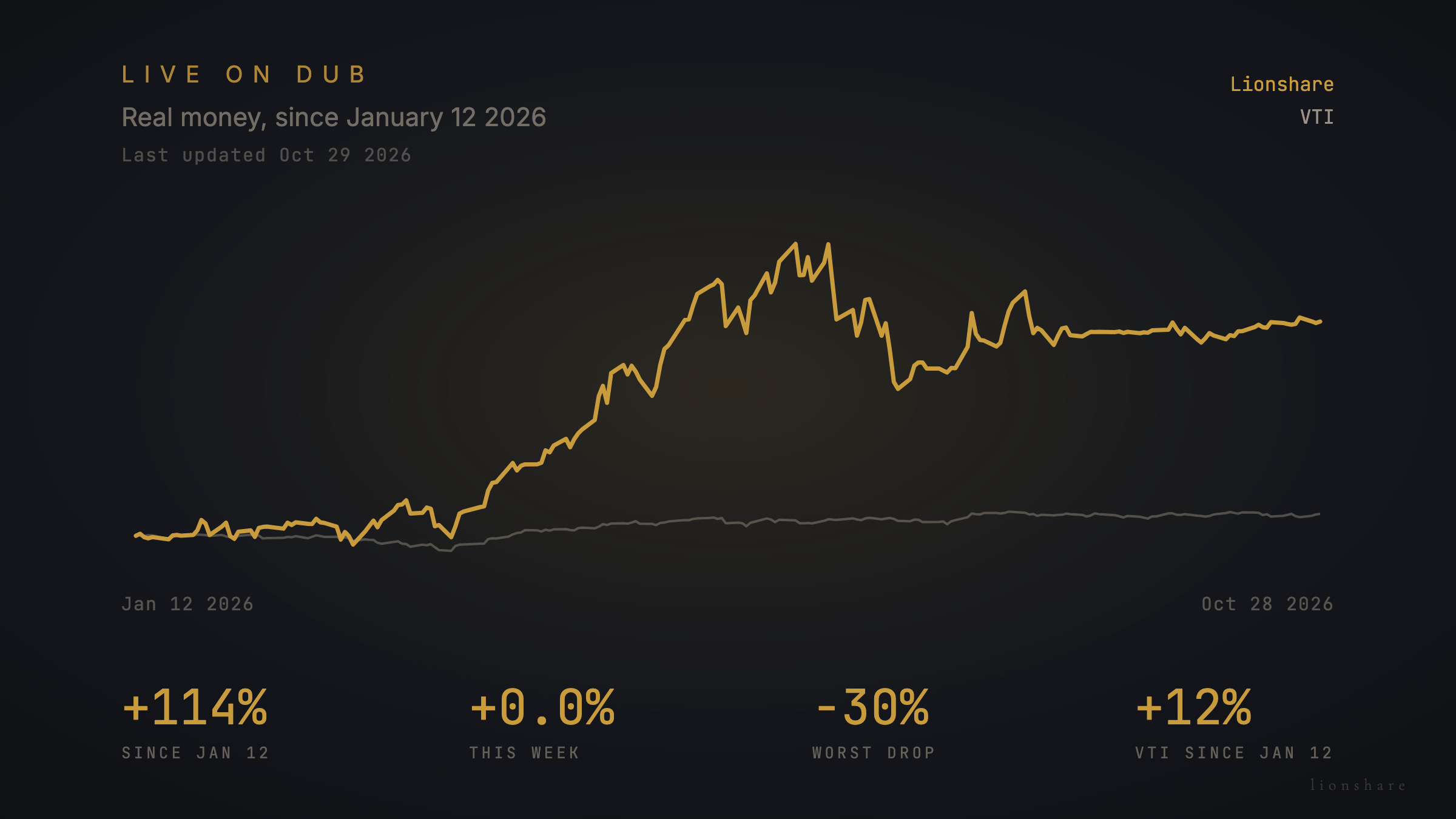
Live portfolio against VTI (all US equity index) from Jan 12 to Oct 28 2026
So the strategy overall is tracking well against the backtested stats. Its return rate, risk-adjusted reward, like Sortino and Sharpe, and max declines are all in line with the portfolio, or at least the backtested results.
And the live results are encouraging to keep going for many more years.
So is it even worth doing? Is Lionshare even worth following? The index that I compared to is VTI, mostly because this is what Dub uses as a reference point, and Dub is the live portfolio that is independently tracked for our live record, that anyone can go and see how the portfolio is performing. It is a total market index, but I also compare it against the S&P 500. My point of view is that this portfolio and any strategy should outperform the reference by a wide margin to make it worth it. Because after you consider the effort you're putting in every week to balance the portfolio and the amount of taxes that come with active trading versus passive investments over long-term holding periods, it needs to be significantly better than just having the index.
Because then, of course, if it wasn't, the better option for investment would just be to buy the S&P 500 and hold for the long term or similar kind of strategies. So I need to make sure, and I keep evaluating the portfolio to see if it does outperform the index by a wide margin.
So far in the live portfolio, since the 12th of January 2026, it has outperformed the market by a wide margin, almost 10 times more. And the Sortino ratio is about 1.7 times the market's. So per unit of risk, we are getting better returns.
Naturally, nine months in is not yet a full market cycle. In the grand scheme of things, it is a very short amount of time to evaluate if a strategy is really effective or just has a good streak. I don't think it is granted that this nine months means that this strategy is fully signed off and that it is a fully functional strategy. But I also think that it is meaningful to see a strategy that was backtested over a significant amount of time, showing similar results in live performance. And I keep investing my own money in this portfolio. So it is fundamentally driven by myself, and its original purpose is to be an investment strategy that I follow with my own capital.
And secondary is that I share with others so that they can find the strategy that I was looking for when I was interested in investing in a more aggressive, higher growth fund. That's it.
When I set the goal for $30,000 to $1 million, I started with $30,000 because this felt like a significant amount of money that I could invest, but also not too much that if I were to lose it all, it would have a completely negative effect on my current situation and life. Of course, losing this amount of money changes many things, but I'm fortunate that it would not put me in a completely desperate situation that is too difficult to recover from. But similarly, it's big enough that the growth that this portfolio can deliver would add up to a significant amount of money, which is $1 million, which is an aspirational goal to get to. I don't see that it will be done easily. I don't think that it will be linear and that it will keep on growing. But I do have faith that I will keep evolving the strategy and keep making the right decisions to have the strategy execute consistently and over time start to compound and really accelerate towards this $1 million goal.
So if anyone else wants to follow along, the journey is open. The portfolio is there to be shared every week. Just simply subscribe, follow along, and see how it goes. This definitely is for anyone that is looking for a way to invest more actively, to stay in touch with the stock market without being constrained, without having to do it as a second job, that wants to be looking at a more active investment portfolio that is traded every week and is designed for higher growth. But it's not for someone that is really risk averse, that needs to understand or be coached through the fundamentals.
I don't do any deep analysis or share too much of how the strategy itself is built. The purpose of Lionshare is to share an actionable, high-value return portfolio every week.
Every Monday before the market opens I share the portfolio in the open, and every Saturday I report the week's result, good or bad. The full list goes to paying readers every Monday before the market opens. It is $39 a month or $350 a year, and the weekend review is free for everyone.